Best 7-Reel Slots in Australia: How They Work
 Available in US
A practical guide to seven-reel layouts, online play, Australian legal boundaries and the arithmetic behind bonus offers.

Table of Contents
- What Seven Reels Actually Change
- Seven-Reel Games, Machines and the Theatre of Choice
- Seven Reels for Real Money: The Australian Legal Boundary
- Classic Seven-Reel Slots, Without the Nostalgia Trap
- Bonus Promises and the Arithmetic Behind Them
- No Download, No Ceremony: Playing Seven-Reel Games Online
- What a Seven-Reel Casino Means in Australia
- Reading a Seven-Reel Slot Before the First Spin
- Free Seven-Reel Slots with Bonuses, Minus the Fine Print
- The Online Seven-Reel Slot: A Short Verdict
What Seven Reels Actually Change
A seven-reel pokie is not simply a familiar machine stretched sideways. The extra reels alter the visual field, the number of possible symbol relationships, and the way a game explains its chances. In online play, the reels are digital columns rather than mechanical drums, but the basic vocabulary remains recognisable: symbols land in positions, winning combinations are assessed, and the rules determine what counts.
The reel count is only the beginning.
Reels, rows and the visible field
A reel is a vertical column in which symbols appear as the game spins. A seven-reel layout gives the screen seven such columns, with the number of visible symbol positions set by the game’s design. The result is a larger stage for combinations than the compact formats associated with older machines.
That extra space can make the game feel generous before any result is calculated. It is a visual trick with a mathematical shadow. More symbols on screen may create more possible arrangements, but they do not turn a random outcome into a promise.
This page brings together notable casino options for exploring the best 7 reel slots in Australia in 2026. Use the listed licence, bonus, deposit, and payout details to identify which operator best fits your preferences.
License: Curacao eGaming Licence · Min. deposit: A$20 Skycrown Casino operates under a Curacao eGaming Licence and has a minimum deposit of A$20.
License: Curacao eGaming Licence · Min. deposit: A$10 PlayWest operates under a Curacao eGaming Licence and sets its minimum deposit at A$10.
Bonus: up to A$750 + 50 jackpot spins, 35x wagering · Payout speed: crypto ~90 minutes, fiat 1-5 days · Min. deposit: A$30 Kingmaker features a bonus of up to A$750 plus 50 jackpot spins with 35x wagering. Crypto payouts take around 90 minutes, while fiat payouts take 1–5 days, and the minimum deposit is A$30.
License: Curacao (operating since 2017) · Bonus: 250% up to A$2,000 + 50 free spins on the first of six deposits · Min. deposit: A$20 Uptown Pokies has operated under Curacao since 2017 and offers 250% up to A$2,000 plus 50 free spins on the first of six deposits. The minimum deposit is A$20.
License: Curacao · Bonus: up to A$10,000 multi-stage + 500 free spins · Min. deposit: A$20 (POLi) Lucky Dreams offers a multi-stage bonus of up to A$10,000 together with 500 free spins. Its minimum deposit is A$20 when using POLi, and it operates under Curacao.
License: Curacao eGaming (Roby Games Ltd) · Bonus: 100% up to A$750 + 200 free spins Roby Casino operates under a Curacao eGaming licence held by Roby Games Ltd. Its offer includes 100% up to A$750 plus 200 free spins.
License: Curacao · Bonus: 100% up to A$500 + 200 free spins, 10x wagering · Payout speed: crypto 30-60 minutes, fiat 1-5 days · Min. deposit: A$10 Wild Tokyo operates under Curacao and offers 100% up to A$500 plus 200 free spins with 10x wagering. Crypto payouts take 30–60 minutes, fiat payouts take 1–5 days, and the minimum deposit is A$10.
License: Curacao eGaming OGL/2024/923/0383 (Antillephone N.V.) · Bonus: up to A$2,000 + 100 free spins across 2 deposits · Min. deposit: A$30 WinSpirit Casino holds Curacao eGaming licence OGL/2024/923/0383 from Antillephone N.V. Its offer provides up to A$2,000 plus 100 free spins across two deposits, with a minimum deposit of A$30.
License: Curacao · Bonus: up to A$2,000 Golden Pokies operates under Curacao and offers a bonus of up to A$2,000.
Bonus: up to A$7,500 + 550 free spins across 10 deposits, 50x wagering · Payout speed: crypto under 1 hour, PayID 1-3 business days · Min. deposit: A$20 (A$30 to qualify for the bonus) Ricky Casino offers up to A$7,500 plus 550 free spins across 10 deposits, with 50x wagering. Crypto payouts take under an hour, PayID payouts take 1–3 business days, and the minimum deposit is A$20, or A$30 to qualify for the bonus.
Digital reels also allow software to control presentation in ways a physical cabinet could not. Symbols can disappear, fall into new positions, expand, or remain locked while other parts of the layout change. The screen may look busy; the underlying result is still governed by the game’s rules and its Random Number Generator (RNG).
Symbols are the grammar
Symbols are the words from which a pokie builds its small sentences. Standard symbols form combinations, while special symbols change how those combinations are evaluated or what happens next.
A wild symbol can substitute for other symbols, subject to the stated rules. A scatter symbol may trigger a feature without appearing on a conventional payline. Bonus symbols can open a separate mini-game. Multipliers can increase a qualifying win. The terminology sounds theatrical because the format borrows freely from theatre: entrances, reveals, suspense, and a final accounting.
Modern pokies commonly attach several such mechanics to the reel layout:
- bonus spins, which create additional rounds under stated conditions;
- wild and scatter symbols, each with a defined role;
- bonus mini-games, separated from the ordinary spin sequence;
- multipliers, which modify qualifying wins;
- cascading reels, where winning symbols disappear and new symbols occupy their positions;
- progressive jackpots, whose prize structure develops across linked play;
- Megaways mechanics, which vary the number of symbols or available winning routes.
These features do not all belong to every seven-reel game. A seven-reel format is a frame, not a guarantee of spectacle. Some games use the additional reels to create more routes; others use them mainly to enlarge the picture.
Paylines and ways to win
A payline is a defined path across the reels. It may run horizontally, diagonally, or follow another pattern listed in the rules. A winning combination must meet the line’s conditions, including the required symbols and the direction in which they are counted.
Ways-to-win mechanics work differently. Instead of asking whether symbols occupy one of a set of drawn lines, they assess matching symbols across adjacent reels or available positions. The exact method belongs to the individual game. “More ways” is therefore not a complete explanation; the rules must show how positions are counted and what interrupts a sequence.
Megaways mechanics make the distinction especially visible. The number of available winning routes can change as the reel heights or symbol positions change. The screen may therefore present a different mathematical arrangement from one spin to the next. It is dynamic architecture, not a lucky mood.
What the information panel tells
A serious reading of any seven-reel pokie begins with its information panel, not its artwork. The rules normally set out the stake range, the way wins are formed, and the conditions for special features. Where displayed, Return to Player (RTP) describes a long-run statistical average calculated across tens of millions of spins. It is not a personal-session return and does not predict the next result.
Variance, where provided, describes the rhythm of payouts. High-variance pokies pay less often but in larger amounts; low-variance pokies pay more often but in smaller amounts. Neither description changes the independence of individual spins.
The panel may also state feature conditions, limits, and the treatment of special symbols. Those details are not decorative legalese. They define the game more accurately than a title promising treasure, thunder, or a very determined animal.
Reel Layout Seven columns
Core Mechanic RNG-governed outcomes
Key Feature Variable paylines and ways-to-win
The spin remains independent
The RNG operates independently of time, player traffic, and external factors. Each spin is independent, and the previous result has no bearing on the next. A long run of losses does not make a win due; a recent win does not make another one less possible.
That principle matters more as the layout becomes elaborate. Cascades, multipliers, bonus spins and changing routes can make a sequence appear to have momentum. The animation supplies the drama. The RNG supplies the result.
So the real change created by seven reels is one of structure and expression. The format can hold more symbols, more routes and more layered features, while the rules determine how those elements interact. The screen may offer a larger vocabulary. Chance still writes the sentence.
Seven-Reel Games, Machines and the Theatre of Choice
A seven-reel game exists in two overlapping worlds. In one, it is software: a set of visual rules, symbols and programmed outcomes displayed on a screen. In the other, it is a machine in the older social sense: a cabinet placed among other cabinets, surrounded by sound, light and the quiet choreography of people deciding whether to stay for another spin.
The format matters in both settings, but it does not determine the whole experience. A 7-reel slot game may borrow the appearance of a traditional pokie while behaving like a highly animated digital product. Another may use the same number of reels as a restrained visual frame, with slower pacing and fewer interruptions. Seven reels are a category marker, not a personality.
From cabinet to screen
The traditional 7-reel slot machine is understood through its physical presence. Its cabinet gives the game a location. Buttons, a screen, speakers and illuminated trim turn the act of spinning into a small public performance, even when nobody is watching closely. In a venue, the machine belongs to a room with its own customs: clustered seats, familiar noises and the peculiar concentration created by many independent games operating side by side.
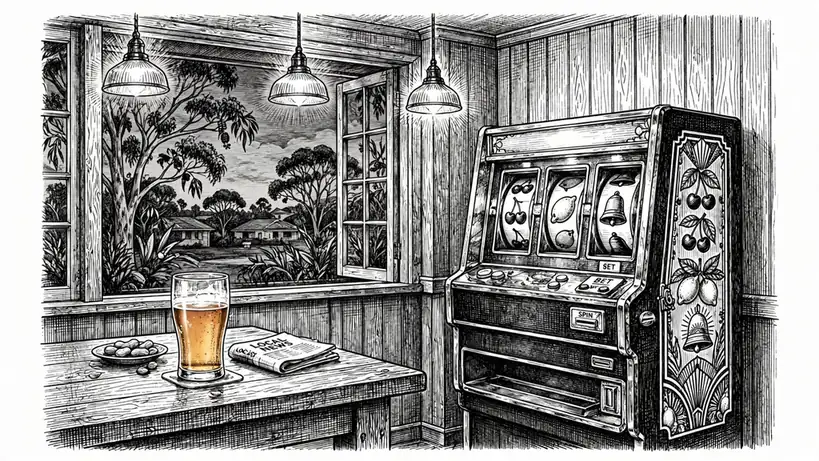
The digital version removes most of that furniture. A browser or mobile display can present the same broad idea without a cabinet, while the surrounding environment becomes private, portable or simply less theatrical. The game no longer needs a dedicated corner of a venue. It arrives as an interface.
That change is more than cosmetic. A cabinet gives the machine weight and permanence; software gives it adaptability. Themes, animations and interface elements can be changed without rebuilding the object. The seven-reel game can therefore appear as a simulation of an older machine, a brightly designed contemporary pokie or something that barely acknowledges the cabinet tradition at all.
The old machine remains useful as a cultural reference. It explains why the language of reels, symbols and spinning survives even when the reels are digital images rather than physical components. A screen can imitate movement. It cannot reproduce the exact social meaning of a machine standing in a room, unless the room is supplied by the imagination.
One format, several moods
The phrase “seven-reel slot machines” suggests a family resemblance, but resemblance is not sameness. A free 7-reel slot machine game may be built for visual exploration, with the emphasis placed on theme and motion rather than the atmosphere of a venue. Another digital game may feel deliberately mechanical, using familiar sounds and compact displays to echo an older pokie.
The difference often lies in pacing. Some games make every stage visible: symbols arrive, effects unfold and the result is presented as a sequence. Others keep the presentation brisk. Neither approach changes the underlying independence of the spin, but each changes how the player experiences time.
Variance also shapes the mood of a game. High-variance pokies pay out less often but in larger amounts. Low-variance pokies pay out more often but in smaller amounts. That distinction does not turn a seven-reel format into a promise of a particular outcome; it describes the rhythm associated with the game’s design. One machine may feel sparse and dramatic. Another may feel more conversational, with smaller events appearing more frequently.

The theatre is therefore not only visual. It is statistical, emotional and social. A player may choose a game because its cabinet resembles an established style, because its digital presentation is energetic, or because its variance produces a rhythm that feels more compatible with the intended session. The same reel count can host all three preferences.
The software behind the curtain
Digital seven-reel games are not mechanical objects pretending to be software. They are software using the visual grammar of machines. Their outcomes are produced by a Random Number Generator, or RNG, which operates independently of time, player traffic and external factors. Each spin is independent; the previous result has no bearing on the next.
That fact quietly separates the machine from the theatre surrounding it. Lights may flash, music may swell and an animation may stretch a moment of anticipation, but presentation does not gain influence over the next result. The spectacle is real as design, not as control.
For licensed Australian-facing platforms, the RNG is required to be independently audited. The audit belongs to the integrity of the software, while the cabinet, theme and sound belong to its public face. Confusing the two is easy because games are designed to make technical processes feel like events. A glowing screen gives randomness a stage entrance.
This is why free 7-reel slot games can resemble paid play without carrying the same social meaning. The interface may reproduce the motion, sound and visual grammar of a 7-reel slot machine, yet the surrounding context is different. The simulation demonstrates the form. It does not transform software into a physical venue or make the theatre itself authoritative.
Seven reels, then, are best understood as a meeting point between object and image. The cabinet supplies history; the software supplies flexibility; the RNG supplies independent outcomes. Around them gathers the human preference for ritual, repetition and a little ceremony before the result appears.
The machine is visible. The mechanism is not.
Seven Reels for Real Money: The Australian Legal Boundary
The phrase “real money” changes the question before a single reel turns. A seven-reel game can be played with no financial stake, or it can sit inside a service that accepts deposits and pays out winnings. The screen may look identical. The legal position is not.
Legal Restriction Online casino games and pokies offered for money are prohibited interactive gambling services in Australia under the Interactive Gambling Act 2001.
In Australia, online casino games and online pokies offered for money are prohibited interactive gambling services. The Interactive Gambling Act 2001 prohibits companies from offering certain online gambling services to people in Australia without authorisation, and the Australian Communications and Media Authority identifies online casino games and online slots among the prohibited services. There is no domestically licensed real-money online casino for Australian players.
That boundary matters because presentation can be remarkably persuasive. A website may use Australian spelling, display A$, describe a game as a “casino” product, or make access technically possible from Australia. None of those details creates permission. Branding is not a licence. Currency is not a licence. A working webpage is not a licence.
Real money and free play are different products
Free online seven-reel slot games belong to a different category when no money is deposited, wagered or withdrawn. They can reproduce the visual language of pokies and may include bonus spins, expanding symbols or other game features. A free online seven-reel slot with a bonus remains a demonstration-style experience if the bonus has no cash value and cannot be converted into a withdrawal.
The distinction is therefore not decorative. It rests on what the service allows money to do. If funds can be staked on spins and winnings can be withdrawn, the service has crossed into real-money gambling. Calling the game entertainment, practice mode or a promotional feature does not change that substance.
This is why searches for seven-reel games to play for real money can produce a misleading mixture of free games, overseas services and ordinary advertising copy. The label may be clear; the legal status may not be. Australian wording does not turn an offshore casino into an Australian-licensed operator, and foreign licensing does not authorise casino services for Australian customers.

What remains lawful
The lawful alternatives are physical casinos, licensed bookmakers and lotteries. These categories are regulated differently and should not be treated as interchangeable. A land-based casino is not an online casino merely because its games use digital screens. A licensed bookmaker is not permitted to offer online pokies as an extra product. A lottery is not a casino account with different scenery.
The wider Australian system is divided between federal and state or territory rules rather than governed by one overarching gambling statute or one national gambling authority. That arrangement can look untidy from the outside, but it draws a firm line around online casino services. Licensed sports and race wagering exists; online pokies do not acquire the same status by borrowing the language of betting.
For people comparing game information rather than seeking a prohibited service, RTP can still be a useful technical measure. A recommendation to consider an RTP above 96% describes a long-run statistical characteristic, not a promise about an individual session. It also says nothing about whether the game is legally available for real-money play in Australia. Arithmetic cannot grant permission.
So the practical division is plain: seven reels may be examined or played for free online, while real-money online casino play is not a lawful Australian product. The reels are familiar. The boundary is not.
Classic Seven-Reel Slots, Without the Nostalgia Trap
A classic seven-reel slot machine is less a relic than a visual language. Bells, bars, cherries, lucky sevens and a narrow line of symbols make the game legible before the rules are opened. The design says what kind of entertainment is on offer: brief decisions, visible outcomes, and a cabinet that looks as though it belongs beside a pub counter rather than inside a software catalogue.
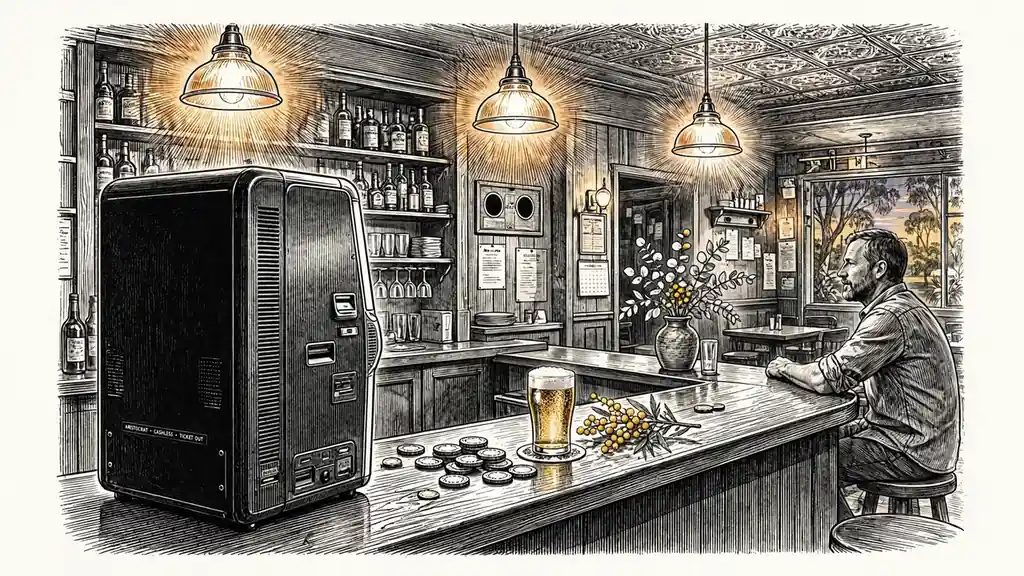
That familiarity can be useful. It reduces the amount of interpretation demanded by a spin. There are fewer layers of animation, fewer feature screens and less visual noise competing for attention. The trade-off is equally plain: a traditional layout may offer fewer modern mechanics, and its charm can do work that mathematics cannot.
The appeal of the old vocabulary
Classic seven-reel slots online borrow heavily from land-based machines. Their symbols are deliberately recognisable, their sound effects tend towards punctuation rather than spectacle, and the interface often keeps the bet controls in plain view. A game such as Starburst belongs to the more contemporary end of this visual tradition, although its low variance and expanding wilds give it a distinct identity rather than making it a simple replica of a mechanical cabinet.
The attraction is partly social. Land-based pokies place gambling among other ordinary activities: conversation, meals, sport and the slow choreography of a venue. The machine is not merely a game but a piece of furniture with a public address. Online, that setting disappears. The screen preserves the symbols while removing the room around them. Nostalgia survives the journey rather well; context does not.
This is why “classic” should not be confused with “simple”. A restrained presentation may conceal detailed rules, feature conditions or a wide stake range. Online pokie bets may run from a few cents to hundreds of dollars per spin, so the modest appearance of a game says nothing reliable about the financial scale of play. A cherry is not a risk assessment.

Land-based setting, modern restrictions
For Australians, the land-based venue remains the lawful setting in which casino pokies can be encountered. Legal options include land-based casinos, alongside licensed bookmakers and lotteries, though those are different products with different rules and should not be treated as interchangeable forms of casino play.
The venue itself is changing. Carded play and restricted hours have been discussed as new reforms for land-based venues in Australia, according to a specialist industry review. That wording matters: these are reforms under discussion in the cited account, not a universal operating rule to be quietly attached to every casino in the country.
A physical machine also makes the relationship between player and institution visible. Opening hours, venue policies, identity checks and local regulation are not background details hidden behind a login screen. They are part of the experience, sometimes awkwardly so. The old cabinet has acquired paperwork.
Free play and the replica problem
Free online seven-reel slot machines can reproduce the look of a classic cabinet without reproducing its social or regulatory setting. In a free-play version, the symbols, reels and sound may remain intact while the monetary consequence is absent. That makes it suitable for examining the interface and deciding whether the format itself holds attention.
It does not turn the game into a land-based machine, and it does not create a route to real-money casino play. “Play free” describes the mode, not a licence, venue or legal permission. The distinction is dull, which is precisely why it is useful.
The strongest case for classic seven-reel design is therefore not that it is superior. It is that it remains readable. Its weakness is that familiarity can make the experience feel safer than it is. Strip away the bells and the nostalgia, and the central question returns: what does the game actually disclose about its rules, stakes and conditions? Everything else is set dressing.
Bonus Promises and the Arithmetic Behind Them
A bonus attached to a seven-reel pokie is not a second balance waiting patiently beside the first. It is conditional credit. The advertisement may display a generous figure; the rules decide what that figure can become, and whether it can ever be withdrawn as cash.
That distinction matters especially when a promotion is described as a way to enjoy bonus spins or real-money play. The reels may be identical, but the money attached to them is not. A bonus balance generally has to satisfy wagering conditions before a withdrawal is permitted. Until then, it remains promotional credit, not income.
The headline figure is only the starting point
Consider a 100% matching offer capped at A$2,000. A deposit of A$1,000 is required to receive the full A$2,000 bonus. A smaller deposit produces a smaller match; the cap does not turn every deposit into the advertised maximum.
The arithmetic becomes less flattering once wagering is added. A A$100 bonus with a 30x wagering requirement demands A$3,000 in wagering before withdrawal. The multiplier applies to the bonus amount in this example, not to the emotional force of the headline.
A larger welcome figure can create a much larger obligation. A A$7,000 bonus carrying a 50x requirement would require A$350,000 in wagering before withdrawal. The offer may still be mathematically clear, but clarity is not the same as generosity.
This is why the phrase “free seven-reel bonus slots” needs careful reading. “Free” can describe the promotional credit, not unrestricted access to cash winnings. A bonus can fund spins, yet the resulting balance can remain locked until the stated conditions are met.
The quiet clauses do the real work
The wagering multiplier is only one part of the terms. A bonus may also carry a maximum stake while bonus funds are active. A profile-specific casino review reports caps of A$5–A$10 per spin or hand in some offers. Such a limit can make an otherwise familiar seven-reel game operate under different practical conditions: a preferred stake may no longer be permitted, and a breach of the rule can affect eligibility for withdrawal.
The wording matters. “Per spin or hand” is not a universal rule for every promotion; it is a condition that has to be checked in the offer attached to the account. Marketing copy rarely gives that clause the largest type.
The same caution applies to expiry. A profile-specific casino review states that bonuses may expire within 7–30 days of being credited. Once the period ends, unused promotional funds or related eligibility may disappear according to the terms. A bonus with an attractive value but a short life is not equivalent to cash held without conditions.
Seven-reel games can therefore appear in several different arrangements: free play without a cash balance, promotional play tied to wagering, or a real-money stake subject to the rules of the service. The reels do not explain the offer. The arithmetic does.
Bonus Wagering
Note the total bonus amount and the required wagering multiplier (e.g., A$100 bonus with 30x wagering).
Multiply the bonus by the requirement to find the total wagering needed (A$100 × 30 = A$3,000).
Verify if there are maximum stake limits per spin that could affect your ability to meet the requirement.
No Download, No Ceremony: Playing Seven-Reel Games Online
A browser can turn a seven-reel pokie into a small, immediate piece of software. No installation package is required, and no cabinet has to be found before the reels appear. For free play, that simplicity is the main attraction: a game opens in the browser, loads its interface, and offers a demonstration of the format without involving a cash stake.
This is the practical meaning behind free seven-reel games online. The experience is closer to a playable sample than to a gambling service. It can show how the reels are arranged, where the rules are stored, how a bonus feature is triggered, and whether the visual pace feels tolerable rather than exhausting. Convenience, in this case, is not a financial promise. It is merely fewer ceremonies between curiosity and a spin.
What the browser version can show
A no-download game may reproduce much of the language associated with modern pokies:
- wild and scatter symbols;
- bonus mini-games;
- multipliers;
- cascading reels;
- progressive jackpot displays;
- Megaways mechanics;
- bonus spins.
The presence of these features does not make the game a real-money product. A demo-style version can imitate the sequence, graphics and sound while keeping the outcome outside a withdrawable balance. The distinction is easy to miss because the interface may look deliberately complete. Slot design has always understood that presentation does part of the persuading.
The useful information is found in the rules rather than the animation. Where displayed, the information may include the stake range, Return to Player, variance description, feature conditions and stated limits. Those details explain what the game claims to do. They do not turn a free session into regulated gambling, nor do they establish that any particular online service is authorised to provide casino play in Australia.
Randomness without a wager
Online pokies use a Random Number Generator, or RNG, so each spin is independent and random. That applies to the game’s underlying result, not to a player’s impression that the reels are becoming “due”. A run of symbols in a free version is not a rehearsal for a later cash outcome. The browser does not keep a secret emotional ledger.
Free play can therefore be useful for learning the interface, but it cannot demonstrate personal profitability. Return to Player is a long-run statistical average, not a promise attached to a session, and a displayed variance description is a guide to payout rhythm rather than a forecast. Even the most polished seven-reel presentation remains a model of the product’s mechanics.
No download. No ceremony. No cash claim.
What a Seven-Reel Casino Means in Australia
A seven-reel casino in Australia is best understood as a venue, not merely a game title. The phrase may describe a casino floor containing electronic machines with seven digital or visible reels, but the legal character comes from the institution operating them. A machine inside a licensed land-based casino belongs to a regulated venue with its own entry rules, operating conditions and responsible-gambling controls. The same visual format placed on a website does not inherit that status by costume.
That distinction matters because Australian gambling is divided by product and channel. Land-based casinos are one category. Licensed bookmakers handle sports and race wagering. Lotteries form another licensed category. None of these permissions automatically extends to online casino games. A bookie may lawfully offer betting products without becoming an authorised online casino, while a lottery licence says nothing about reel-based casino play.
Under the Interactive Gambling Act, real-money online casinos offering pokies to Australians are banned. There is no Australian casino licence that turns a website offering those games into a domestic equivalent of a casino floor. Australian wording, A$ pricing and a familiar machine theme cannot create that permission. Branding is not regulation. A rather expensive misunderstanding.
The institutional difference also explains why a land-based casino and an online page can feel similar while operating under entirely different rules. In a physical venue, the machine sits within a broader system of opening conditions, venue supervision and state or territory regulation. An online service is assessed by the product it provides to an Australian customer, not by how convincingly its interface imitates a room full of machines.
Reforms discussed for land-based venues include carded play and restricted hours. A specialist industry review presents these as developments in the treatment of physical gambling venues, not as a universal rule that can be casually assigned to every casino or every state. The qualification matters: Australian gambling regulation is not one seamless national code wearing a single badge.
So the phrase “reel 7 casino” points to a format, while “casino” points to a regulated setting. The reels may be counted on the screen; the permission is counted elsewhere—in the venue’s legal category, jurisdiction and product rules. For Australians, those categories should remain separate. A machine, a bookmaker and a lottery are not interchangeable institutions, however brightly their interfaces happen to glow.
Reading a Seven-Reel Slot Before the First Spin
A seven-reel slot can look busy without being difficult to read. Three figures and one rule provide a calmer starting point: Return to Player (RTP), variance, and the behaviour of the Random Number Generator (RNG).
RTP Is Not a Session Forecast
RTP is a long-run statistical average calculated across tens of millions of spins. It describes the mathematical expectation of a game over an enormous sample, not the amount returned during one evening, one deposit, or one run of bonus spins.
That distinction matters because a high displayed RTP cannot turn a short session into a predictable transaction. The figure belongs to the game’s long horizon. Individual results can sit well above or below it, sometimes for a considerable stretch. A seven-reel slot does not owe a player the difference.
Variance Describes the Rhythm
Variance concerns the shape of the ride rather than a promise about its destination. High-variance pokies tend to pay less often but in larger amounts. Low-variance pokies tend to pay more often but in smaller amounts.
Neither description makes a game safer, kinder, or mathematically favourable. It explains the rhythm of results: whether wins are likely to arrive as frequent modest events or as less frequent, potentially larger interruptions. That is useful vocabulary when comparing games, provided it is not mistaken for a forecast.
The RNG Has No Memory
The RNG operates independently of time, player traffic, and external factors. Each spin is independent, and the previous result has no bearing on the next one.
A sequence of losses does not make a win “due”. A recent win does not make another win less available. The machine has no mood, no memory, and no sense of dramatic timing. It merely produces the next random result.
Does RTP guarantee a win?
No, RTP is a long-run statistical average calculated across millions of spins and does not predict individual session outcomes.
Is a seven-reel slot more lucky?
No, the additional reels change the structure and visual field, but every spin remains independent and governed by the RNG.
Can I play these games for free?
Yes, many versions are available as no-download browser games intended for demonstration and entertainment without financial stake.
That is the disciplined reading: RTP describes the long run, variance describes the pattern of payouts, and the RNG decides each spin without consulting the last one. The named games that follow can therefore be compared by their stated features, not by imagined momentum.
Free Seven-Reel Slots with Bonuses, Minus the Fine Print
Free seven-reel play and a real-money bonus may share the word bonus, but they belong to different arrangements. A browser game played without a deposit is a demonstration: no cash balance is created, and no promotional condition turns the result into withdrawable money. The “no download” part is merely technical convenience. It changes access, not status.
A real-money promotion carries terms that deserve slower reading than the banner usually receives. A wagering requirement determines how much qualifying play must be completed before a bonus balance can be withdrawn. For instance, a A$100 bonus with a 30x requirement means A$3,000 in wagering before withdrawal. The arithmetic is plain; the wording around it is less charitable.
Contribution rules matter as well. A specialist gambling review reports that pokies contribute 100% towards wagering requirements. That does not mean every balance behaves identically: the promotion’s own terms still determine which games qualify, whether bonus funds must be used first, and whether a maximum stake applies while the offer is active.
Expiry is another quiet trap. A specialist gambling review states that bonuses expire within 7–30 days of being credited. Once that period ends, an unfinished offer may disappear, along with any associated bonus balance. A free seven-reel game has no comparable countdown because it is not a cash promotion.
The practical distinction is therefore narrow but important:
- Free play: entertainment or feature testing, with no withdrawable winnings.
- Bonus play: a conditional credit attached to real-money activity and wagering rules.
- Cash balance: subject to the account’s applicable terms, not created merely by spinning a demo game.
A seven-reel layout does not soften the fine print. It only gives the fine print more reels to hide behind.
The Online Seven-Reel Slot: A Short Verdict
A seven-reel slot played online can offer a particular visual and structural experience, but it cannot offer certainty. The reels may carry more symbols, more combinations or a more elaborate feature path; none of that changes the underlying randomness of each spin. The result before it has no influence on the result after it.
That independence is not a decorative technical detail. The Random Number Generator operates independently of time, player traffic and external factors. A quiet session does not make a win more likely. A crowded platform does not make a loss more meaningful. The machine has no memory, despite the very human tendency to assign it one.
Return to Player, or RTP, belongs to a different scale. It is a long-run statistical average calculated across tens of millions of spins, not a promised return for an individual session. A displayed RTP may help describe the mathematical design of a game, but it cannot predict what happens during one visit, one deposit or one sequence of spins. Statistics are patient. People rarely are.
The Australian setting adds a boundary that presentation cannot erase. An online seven-reel slot does not become lawful for Australian customers because its page uses A$, Australian spelling or local imagery. Currency is formatting, not permission. Nor does website availability establish authorisation. The appearance of a service can be remarkably confident; legality is less theatrical.
So the sensible verdict is narrow:
- Randomness: each spin stands alone.
- RTP: a long-term measure, never an individual guarantee.
- Presentation: seven reels may change the design, not the independence of outcomes.
- Australian wording: no legal shortcut.
- A$ pricing: no legal shortcut either.
That is what the format can promise: a defined digital game governed by stated mathematics. It cannot promise a result, a recovery, or a lawful route created by branding. Clear enough.
What does a licensed online casino Australia actually mean?
For Australians, a licensed online casino cannot legally offer real-money online casino games or slots under the Interactive Gambling Act. Legal gambling options include land-based casinos, licensed bookies, and lotteries.
Best aussie online casinos to play pokies for real money?
Real-money online casinos offering pokies to Australians are banned under the Interactive Gambling Act. Australians can legally play pokies at land-based casinos instead.
Can I legally deposit and withdraw money to online casinos?
Real-money online casino games and slots are prohibited for Australians under the Interactive Gambling Act. Legal alternatives include land-based casinos, licensed bookies, and lotteries.
Written by the editors at Casino Info Au.